
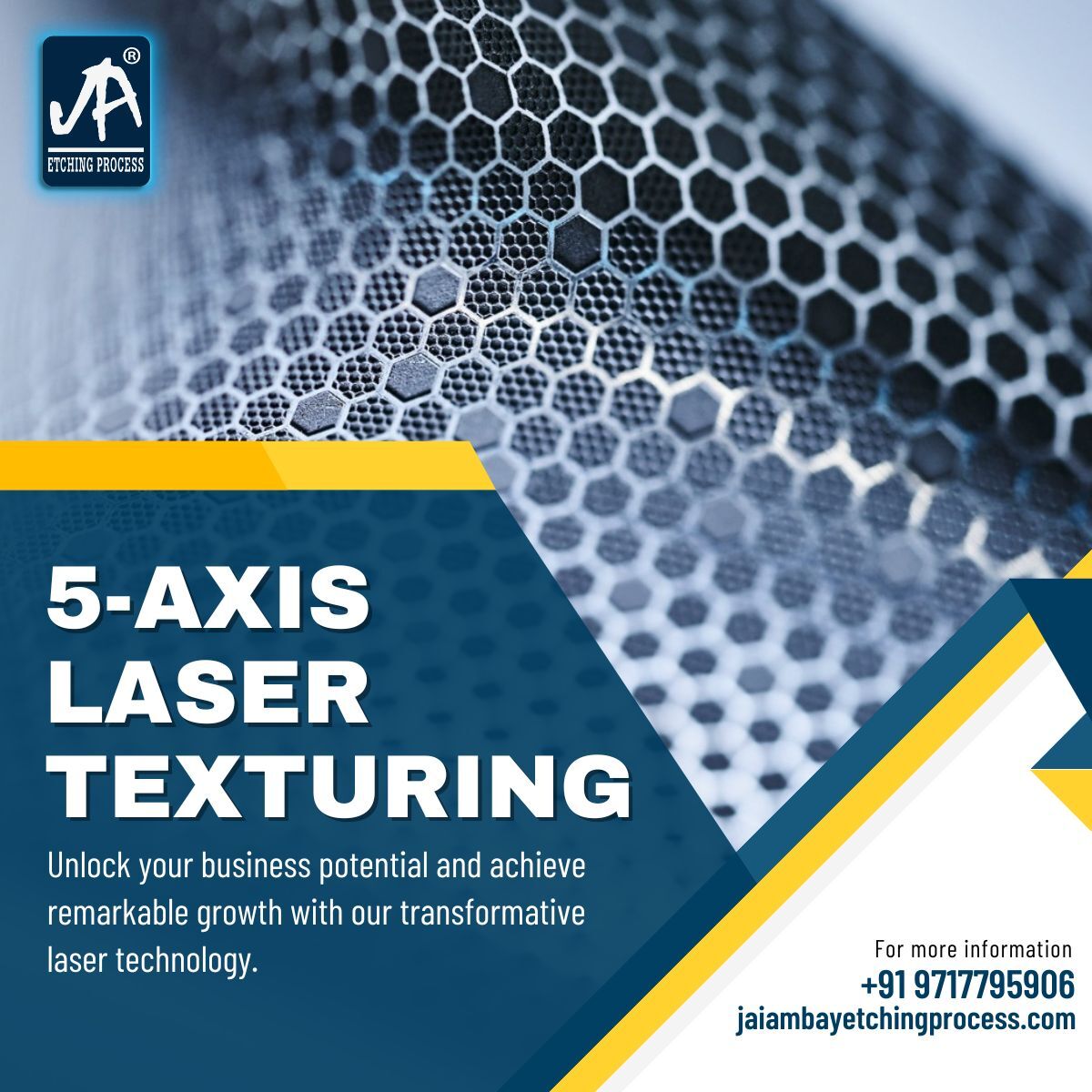
What is 5 Axis Laser Texturing?
5 Axis Laser Texturing is an advanced manufacturing technology used to create highly detailed surface textures on complex components. The system uses a high-energy laser beam controlled by a five-axis motion system, allowing the laser to engrave patterns from multiple angles.
Unlike traditional mechanical texturing methods, this process is non-contact, meaning the laser does not physically touch the material. The laser removes microscopic layers from the surface to create precise textures.
Industries use 5 axis laser texturing technology to improve product appearance, enhance grip, control friction, and create functional surface patterns.
5 Axis Laser Texturing Process
The 5 axis laser texturing process involves several stages to achieve accurate and repeatable surface patterns.
1. Surface Design Creation
Engineers design the texture pattern using specialized CAD or 3D design software.
2. Material Preparation
Technicians clean and prepare the material surface to ensure proper laser interaction.
3. Machine Programming
The system receives instructions for texture depth, pattern density, and engraving speed.
4. Laser Texturing Operation
The multi-axis system moves the laser beam across the surface to create the desired texture.
5. Inspection and Quality Control
Technicians inspect the final surface to ensure the texture meets design specifications.
This process provides highly consistent and accurate results.

5 Axis Laser Texturing Machine
A 5 axis laser texturing machine is designed to work on complex and curved surfaces. The five-axis movement allows the laser head to rotate and reach multiple angles.
Key components include:
-
High-power laser source
-
Multi-axis CNC motion system
-
Precision laser optics
-
Computer-controlled software
-
Cooling and safety systems
These machines are widely used in industries that require precise surface engineering.
Industrial Laser Texturing
Industrial laser texturing is widely used in manufacturing industries to modify surface properties and improve product performance.
Industries that use this technology include:
-
Automotive manufacturing
-
Aerospace engineering
-
Plastic mold production
-
Consumer electronics manufacturing
-
Medical device manufacturing
Industrial texturing improves product functionality and visual appearance.
Laser Surface Texturing Technology
Laser surface texturing technology uses controlled laser energy to create micro-level patterns on material surfaces.
Benefits of this technology include:
-
High precision and repeatability
-
No tool wear or mechanical damage
-
Ability to create complex textures
-
Improved surface performance
Manufacturers use this technology to enhance surface friction, lubrication control, and decorative finishes.
Precision Laser Texturing
Precision laser texturing focuses on creating extremely accurate micro textures on surfaces. The laser can produce patterns with micron-level accuracy.
Applications include:
-
Mold and die texturing
-
Automotive component surfaces
-
Industrial tools and equipment
-
High-performance engineering parts
Precision texturing ensures consistent performance across large production volumes.
Advanced Laser Texturing System
An advanced laser texturing system combines powerful laser technology with intelligent software control. These systems allow manufacturers to create complex surface patterns efficiently.
Key advantages include:
-
Automated production workflow
-
High-speed laser operation
-
Accurate texture replication
-
Reduced production time
This technology helps industries improve productivity and reduce manufacturing costs.

Comparison Table – Traditional Texturing vs 5 Axis Laser Texturing
| Feature | Traditional Surface Texturing | 5 Axis Laser Texturing |
|---|---|---|
| Process Type | Mechanical engraving | Laser technology |
| Precision | Moderate | Extremely high |
| Surface Damage | Possible | Minimal |
| Design Complexity | Limited | Highly complex |
| Tool Wear | High | No tool wear |
| Production Speed | Moderate | High |
Applications of 5 Axis Laser Texturing
5 axis laser texturing is widely used in many industries due to its precision and flexibility.
Common applications include:
-
Mold and die surface texturing
-
Automotive interior components
-
Consumer product design
-
Industrial tool manufacturing
-
Decorative metal surfaces
-
Functional engineering surfaces
The technology allows manufacturers to create both decorative and functional textures.
Conclusion
5 Axis Laser Texturing is one of the most advanced surface engineering technologies used in modern manufacturing. It provides high precision, excellent surface control, and the ability to texture complex 3D surfaces.
With the help of 5 axis laser texturing machines, precision laser texturing technology, and advanced laser texturing systems, industries can achieve high-quality and consistent surface results.
As manufacturing technology continues to evolve, industrial laser surface texturing will remain an essential solution for improving product performance and design.