
What is Chemical Etching?
Chemical Etching is a precision manufacturing process that removes material from a metal surface using controlled chemical reactions. The process allows manufacturers to create extremely detailed designs and components without using mechanical cutting tools.
In this method, a chemical solution dissolves specific areas of the metal surface while protecting other areas with a masking layer. This technique produces accurate and smooth metal parts.
Industries widely use chemical etching technology for manufacturing electronic components, industrial parts, decorative panels, and medical devices.
Chemical Etching Process
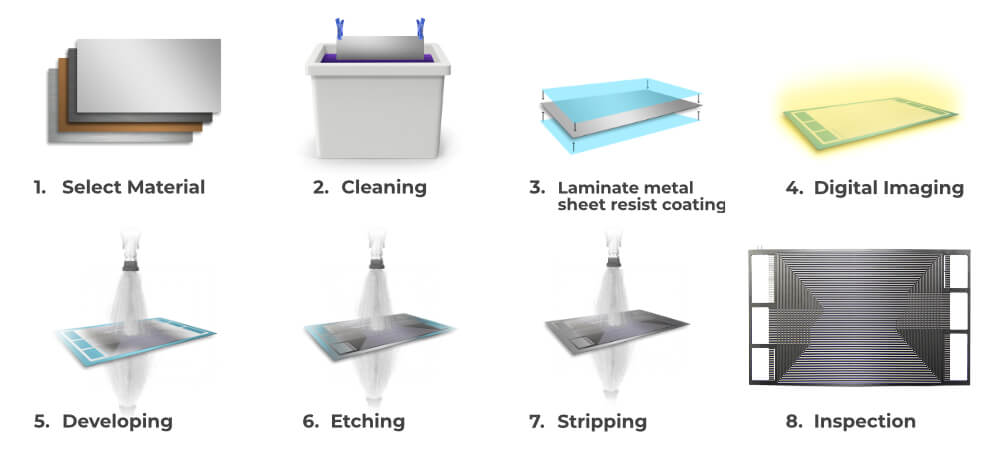
The chemical etching process involves several important steps to ensure precision and quality.
1. Surface Preparation
Technicians clean the metal sheet to remove oil, dirt, and contaminants.
2. Photoresist Coating
A light-sensitive protective layer called photoresist is applied to the metal surface.
3. Pattern Exposure
Engineers transfer the design pattern onto the metal using UV light or imaging techniques.
4. Chemical Etching
The metal sheet is placed in an etching solution that removes the unprotected metal areas.
5. Cleaning and Finishing
Technicians remove the protective coating and clean the finished component.
This process creates highly accurate and burr-free metal parts.
Chemical Etching Technology
Modern chemical etching technology allows manufacturers to produce extremely precise metal components. The process works well for complex designs that are difficult to achieve with traditional machining methods.
Advantages of chemical etching technology include:
-
High dimensional accuracy
-
No tool wear or mechanical stress
-
Ability to produce intricate patterns
-
Smooth edges without burrs
-
Cost-effective for large production volumes
These benefits make chemical etching a preferred manufacturing technique in many industries.

Metal Chemical Etching
Metal chemical etching is commonly used to manufacture precision metal parts from thin metal sheets.
Metals suitable for chemical etching include:
-
Stainless steel
-
Copper
-
Brass
-
Aluminum
-
Nickel alloys
This process ensures smooth surfaces and accurate shapes without damaging the metal structure.
Industrial Chemical Etching
Industrial chemical etching is widely used in modern manufacturing industries that require high precision and detailed metal components.
Industries that use chemical etching include:
-
Aerospace manufacturing
-
Electronics and semiconductor industry
-
Automotive engineering
-
Medical device manufacturing
-
Decorative metal fabrication
Industrial chemical etching allows companies to produce high-quality components efficiently.
Precision Chemical Etching
Precision chemical etching focuses on producing highly detailed and accurate metal parts. The process is ideal for components that require fine features and tight tolerances.
Applications include:
-
Electronic connectors
-
Micro components
-
Medical implants
-
Industrial filters
-
Precision engineering parts
The technology ensures consistent quality even for complex manufacturing designs.

Chemical Etching Manufacturing
The chemical etching manufacturing process allows companies to produce metal components with high accuracy and efficiency.
Key benefits include:
-
Low tooling costs
-
Fast production cycles
-
Ability to manufacture micro components
-
High design flexibility
-
Consistent product quality
Because of these advantages, many industries rely on chemical etching for precision metal fabrication.
Comparison Table – Traditional Machining vs Chemical Etching
| Feature | Traditional Machining | Chemical Etching |
|---|---|---|
| Process Type | Mechanical Cutting | Chemical Material Removal |
| Precision | Moderate | Extremely High |
| Surface Finish | May require finishing | Smooth and burr-free |
| Tool Wear | High | No tool wear |
| Design Complexity | Limited | Highly complex designs |
| Production Efficiency | Moderate | High for thin components |
Applications of Chemical Etching
Chemical etching is widely used in many industries due to its precision and efficiency.
Common applications include:
-
Electronic circuit components
-
Industrial metal parts
-
Aerospace components
-
Medical equipment parts
-
Decorative metal panels
-
Precision metal filters and screens
The technology allows manufacturers to create detailed and high-quality metal components.
Conclusion
Chemical Etching is one of the most advanced and reliable manufacturing technologies for producing precision metal components. The process offers excellent accuracy, smooth surface finishes, and the ability to create complex designs.
With the help of modern chemical etching technology, industrial etching systems, and precision manufacturing methods, companies can produce high-quality metal parts efficiently.
As industries continue to demand precision and efficiency, chemical etching manufacturing will remain a key technology in modern metal fabrication.