
Chemical Etching is a highly accurate and cost-effective metal fabrication process used to create intricate patterns, components, and industrial parts. Industries prefer this method because it delivers burr-free, stress-free, and precise results without mechanical distortion.
Manufacturers use chemical etching for thin metal parts, nameplates, filters, electronic components, and decorative applications. Unlike laser cutting or stamping, this process removes material using controlled chemical reactions instead of heat or physical force.
In this blog, you will learn how chemical etching works, its advantages, applications, and why industries rely on it for precision manufacturing.

Chemical Etching, also known as photo etching or metal etching, is a subtractive manufacturing process. It uses photoresist coating and chemical solutions to dissolve selected areas of metal.
The process allows manufacturers to produce complex geometries with extreme precision while maintaining material integrity.
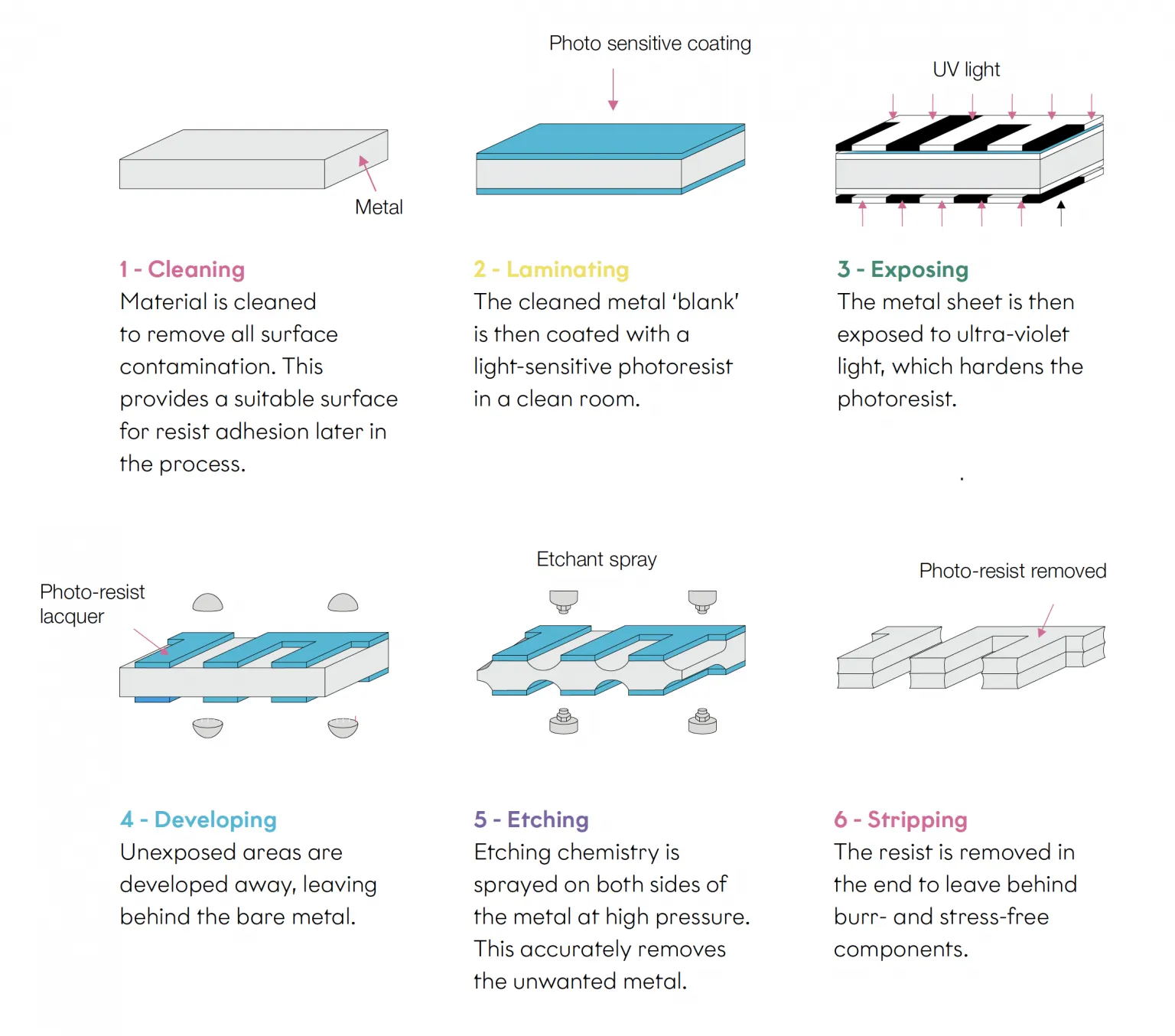
The process follows these key steps:
The manufacturer cleans the metal sheet to remove oil, dust, and impurities.
A light-sensitive resist layer coats the metal surface.
UV light transfers the required design onto the photoresist using a photographic mask.
The exposed areas harden, while unexposed areas wash away.
An etching solution removes the unprotected metal areas with precision.
The manufacturer removes the remaining resist and inspects the final component.
This process ensures high repeatability and dimensional accuracy.

Manufacturers use chemical etching to create ultra-fine components with tight tolerances.
Heavy industries rely on this method for functional parts and mechanical components.
Designers use chemical etching for artistic panels, branding plates, and architectural elements.
The process works exceptionally well for thin materials that may distort under mechanical cutting.
Chemical etching works efficiently on:
Stainless steel
Copper
Brass
Aluminum
Nickel alloys
Titanium
It maintains the mechanical properties of the metal without causing stress or heat damage.
Chemical etching produces extremely fine details and complex patterns with tight tolerances.
The process creates smooth and clean edges without secondary finishing.
Since the process does not use force, it prevents warping and distortion.
It reduces tooling costs compared to stamping or CNC machining.
Manufacturers can quickly modify designs without expensive tooling changes.
The process handles delicate materials without bending or cracking.
Both technologies offer precision, but they serve different purposes.
| Chemical Etching | Laser Engraving |
|---|---|
| Uses chemical reaction | Uses focused laser beam |
| Suitable for thin sheets | Suitable for deep engraving |
| No heat distortion | Heat-based process |
| Cost-effective for bulk production | Ideal for marking and depth engraving |
Industries choose the method based on application, material thickness, and production volume.
Electronics manufacturing
Aerospace industry
Automotive sector
Medical equipment production
Telecommunications
Architecture and interior design
These industries require accuracy, repeatability, and material integrity.
Chemical etching supports innovation in precision engineering. It enables manufacturers to produce lightweight components, micro-parts, and intricate metal designs without increasing costs.
It also reduces material waste and ensures consistent quality across large production runs.
Chemical Etching remains one of the most reliable and precise metal processing methods available today. It offers high accuracy, burr-free finishing, and stress-free manufacturing. Whether you need precision metal components, decorative panels, or industrial parts, chemical etching provides an efficient and cost-effective solution.
By choosing chemical etching, manufacturers improve quality, reduce distortion, and achieve consistent results at scale.
©2026 Jai Ambay Etching Process. All Rights Reserved.
