
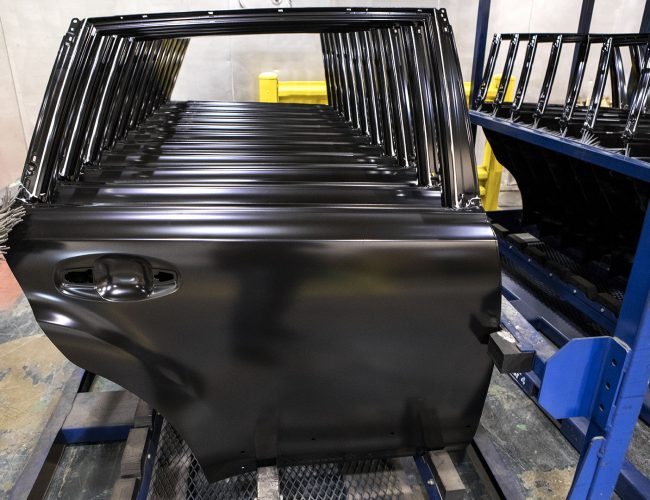
E-Coating is one of the most advanced surface finishing technologies used in modern manufacturing. It provides uniform coating thickness, superior corrosion resistance, and long-lasting protection for metal components.
Also known as the Electrocoating process, Electro deposition coating, or Electrophoretic deposition, this method ensures complete and consistent coverage, even on complex shapes.
This guide explains the process, types, working principle, and industrial advantages in a clear and structured format.
E-Coating is a dip-based painting process that uses electrical current to deposit paint onto a conductive metal surface.
Unlike traditional spray painting, E-Coating ensures:
100% surface coverage
Controlled film thickness
Excellent adhesion
High corrosion resistance
Manufacturers use it extensively in automotive, heavy equipment, and industrial production.
The E-Coating process involves immersing metal parts into a water-based paint bath that contains electrically charged particles. When electric current flows through the system, the paint particles move toward the metal surface and form a uniform protective layer.
This process supports automation and large-scale production.
The E-Coating working principle is based on electrophoresis.
When electricity passes through the coating bath:
Paint particles gain an electrical charge.
The metal component attracts oppositely charged particles.
The coating deposits evenly across the surface.
The film builds until it reaches an insulated thickness.
This self-regulating mechanism ensures uniform and consistent coating results.
There are two primary types of electrocoating systems used in industry.
| Feature | Cathodic Electro Coating | Anodic Electro Coating |
|---|---|---|
| Electrode Role | Part acts as cathode | Part acts as anode |
| Corrosion Resistance | Very high | Moderate |
| Industrial Usage | Automotive & heavy industry | Decorative & light-duty |
| Durability | Excellent | Good |
| Market Demand | Most widely used | Limited |
Cathodic electro coating dominates the market because it offers superior corrosion protection and durability.

Electro deposition coating uses electrical energy to deposit paint particles evenly onto conductive surfaces.
Key advantages include:
Complete coverage of complex geometries
Consistent film thickness
Reduced paint waste
Strong mechanical bonding
This process works effectively for mass production environments.
The E-Coating paint process follows a systematic and controlled sequence.
| Step | Process Stage | Purpose |
|---|---|---|
| 1 | Surface Cleaning | Removes oil and contaminants |
| 2 | Pretreatment | Improves adhesion and corrosion resistance |
| 3 | Electro Deposition | Applies uniform coating |
| 4 | Rinsing | Removes excess paint |
| 5 | Curing | Hardens and strengthens coating |
Each step plays a critical role in ensuring durability and performance.
Electrophoretic deposition is the scientific mechanism behind electrocoating. It uses electrical force to move charged paint particles toward the metal substrate.
This method provides:
Precise thickness control
High transfer efficiency
Automation compatibility
Environment-friendly performance
It ensures reliable coating quality across large production batches.

Excellent corrosion resistance
Uniform thickness on complex shapes
High production efficiency
Low material waste
Long service life
Eco-friendly water-based system
E-Coating reduces operational costs while increasing product durability.
E-Coating is widely used in:
Automotive chassis and body parts
Agricultural machinery
Electrical enclosures
Industrial equipment
Structural steel components
Metal furniture
Industries choose E-Coating because it provides reliable protection in harsh environments.
E-Coating remains one of the most efficient and advanced coating technologies available today. The Electrocoating process, supported by electrophoretic deposition, ensures uniform coverage, strong adhesion, and superior corrosion resistance.
Whether manufacturers use cathodic electro coating for heavy-duty applications or anodic electro coating for decorative finishes, E-Coating delivers consistent and long-lasting results.
Its automation compatibility, durability, and cost-effectiveness make it the preferred solution for modern industrial surface protection.
©2026 Jai Ambay Etching Process. All Rights Reserved.
