
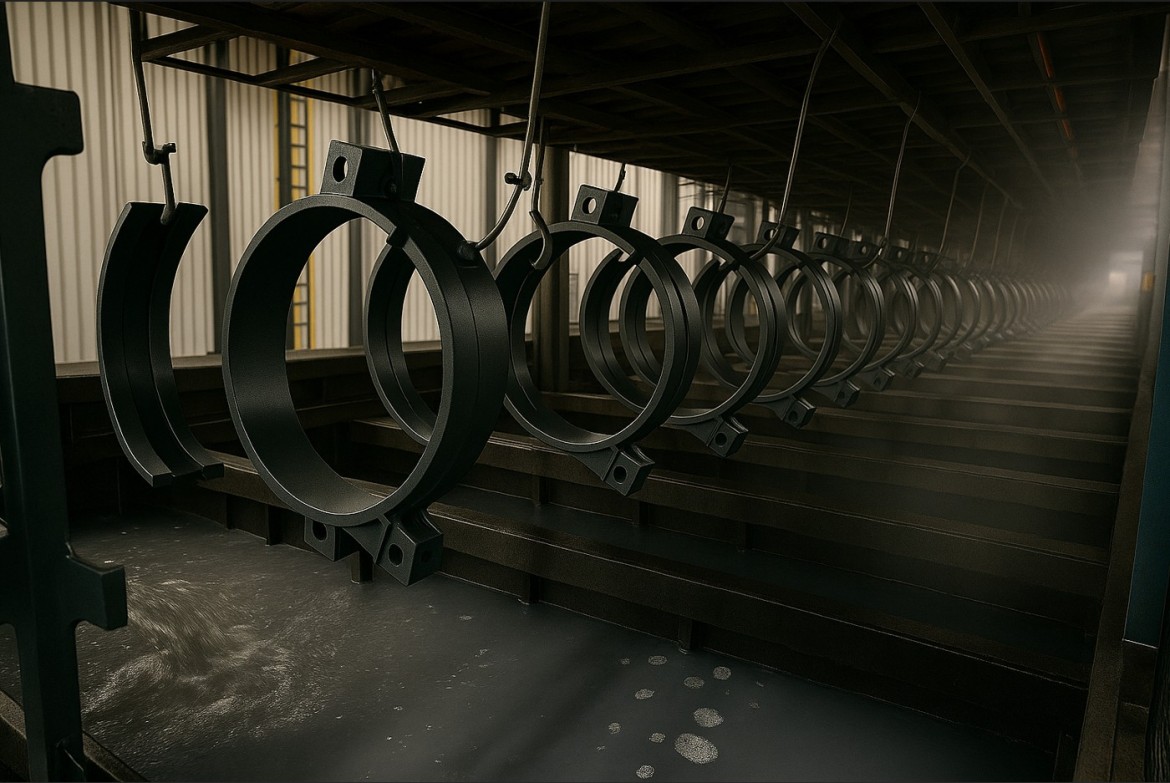
In many industries, protecting metal parts from corrosion is a major concern. Components used in machines, vehicles, and equipment often face moisture, chemicals, and harsh environmental conditions. Without proper protection, these metal parts can quickly develop rust and lose their strength.
This is where E-Coating, also called electrocoating, becomes useful. It is a modern coating method that applies a protective paint layer to metal surfaces using electrical current.
Many manufacturers prefer industrial e-coating because the coating spreads evenly across the entire component. Even small corners, edges, and hidden areas receive the same protection. That is one of the main reasons this technology is widely used in automotive and industrial production.
E-Coating is a process in which electrically charged paint particles are deposited onto a metal surface. The metal component is placed in a special liquid bath that contains coating material.
When electrical current passes through the bath, the paint particles move toward the metal part and stick to its surface. This reaction forms a thin but very durable coating layer.
Because the coating happens through electrical attraction, the paint spreads evenly across the entire surface. This makes e-coating for metal much more consistent than many traditional coating methods.
The e coating process usually involves several controlled stages. Each step plays an important role in creating a strong and long-lasting coating.
The metal surface is cleaned to remove oil, grease, and dust. A clean surface helps the coating attach properly.
The part goes through chemical treatment to improve corrosion resistance and coating adhesion.
The component is dipped into the e-coating paint bath. Electric current is applied, and coating particles begin to attach to the metal surface.
Excess coating material is removed using water rinsing systems.
Finally, the coated part is heated in an oven. This curing stage hardens the paint layer and gives it durability.
After curing, the metal surface becomes smooth, protective, and resistant to corrosion.

Among different electrocoating methods, cathodic e-coating is the most commonly used today.
In this method, the metal part acts as the cathode (negative electrode). Coating particles move toward it and form a protective layer. This type of coating provides better corrosion resistance compared to older methods.
Because of this advantage, cathodic e-coating is widely used for automotive components, industrial machinery, and structural metal parts.
Modern e-coating technology uses automated systems to control temperature, electrical voltage, and coating thickness. This ensures consistent results during mass production.
Some important benefits of this technology include:
Uniform coating on complex shapes
High corrosion resistance
Minimal paint waste
Environmentally safer process
These advantages make e-coating a preferred solution in many manufacturing industries.
Industrial e-coating is used in many sectors where metal components require long-term protection.
Some common applications include:
Automotive chassis and body parts
Electrical enclosures and cabinets
Metal furniture frames
Agricultural equipment
Industrial machinery components
These industries rely on e-coating because it improves both durability and product life.

| Feature | E-Coating | Powder Coating |
|---|---|---|
| Coverage | Excellent for complex shapes | Limited in deep cavities |
| Coating Thickness | Thin and uniform | Thicker layer |
| Process | Liquid electrochemical process | Dry powder spraying |
| Corrosion Resistance | Very high | High |
| Industrial Use | Automotive and industrial parts | Decorative and protective finishing |
Both technologies are useful, but e-coating offers better coverage for intricate metal components.
Many companies provide e-coating services for manufacturers who need corrosion-resistant finishing. These service providers operate specialized coating plants equipped with automated electrocoating systems.
Reliable e-coating manufacturers focus on consistent quality, corrosion resistance, and high production capacity. Choosing the right coating partner ensures better performance and longer product life.
E-Coating has become one of the most effective methods for protecting metal components from corrosion. The process creates a uniform and durable coating that can reach even the smallest areas of a component.
Thanks to advanced electrocoating technology, manufacturers can now protect metal parts efficiently while maintaining high production speed. As industries continue to demand stronger and longer-lasting products, e-coating will remain an essential surface finishing solution.
©2026 Jai Ambay Etching Process. All Rights Reserved.