
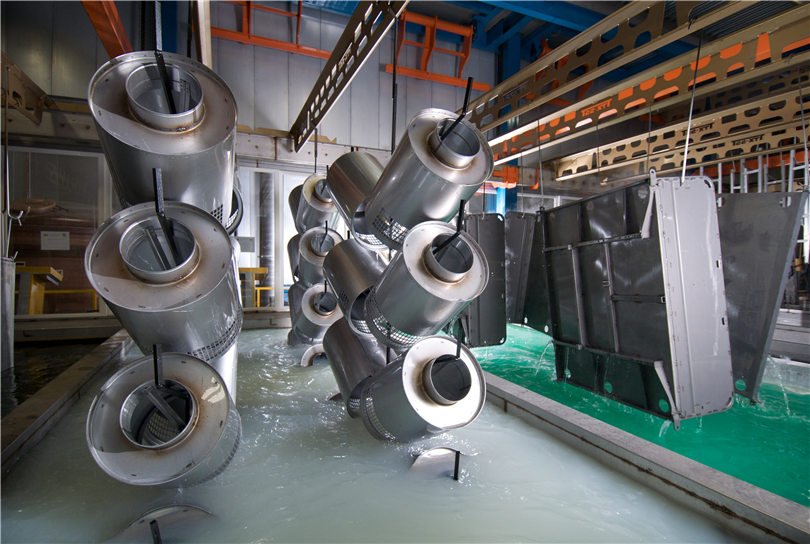
E-Coating (Electrophoretic Coating) is an advanced metal finishing process that uses electrical current to deposit a protective coating onto metal surfaces. The process immerses metal parts in a water-based paint solution and uses electricity to apply a uniform coating.
This method is also known as electrocoating or electrophoretic coating. It is widely used in industries because it provides excellent corrosion resistance and consistent coating thickness.
Manufacturers prefer E-coat coating technology for automotive components, industrial equipment, and metal structures that require long-term protection.
The E-coating process follows several controlled steps to ensure high-quality coating results.
Technicians clean the metal parts to remove oil, dust, and contaminants.
The surface undergoes chemical treatment to improve coating adhesion.
The metal part is submerged in a tank filled with a water-based paint solution.
Electric current passes through the solution, causing the coating particles to bond with the metal surface.
The coated component is rinsed and then baked in an oven to cure the coating.
This process produces a smooth, uniform, and highly durable coating layer.

The electrocoating process is one of the most efficient coating technologies used in modern manufacturing. It allows manufacturers to coat complex shapes and internal cavities evenly.
Key advantages include:
Uniform coating thickness
Excellent adhesion to metal surfaces
High production efficiency
Minimal material waste
Environmentally friendly process
Electrocoating is widely used for protective metal finishes.
Electrophoretic coating works on the principle of electrically charged paint particles moving toward an oppositely charged metal surface.
This technology provides several benefits:
Complete coverage on complex parts
Smooth and defect-free finish
Strong corrosion protection
High durability
Because of these advantages, electrophoretic coating is widely used in industrial applications.
Industrial E-coating is commonly used to protect metal components from corrosion and environmental damage.
Industries that use E-coating include:
Automotive manufacturing
Industrial equipment production
Construction hardware
Agricultural machinery
Electrical equipment manufacturing
The coating increases the lifespan and performance of metal components.
Modern E-coat coating technology uses advanced automation systems to ensure precise and consistent coating results.
Benefits include:
High production efficiency
Reduced coating defects
Lower environmental impact
Improved corrosion protection
Long-lasting coating performance
Manufacturers rely on this technology to protect metal components in demanding environments.

Cathodic E-coating is the most commonly used type of electrocoating. In this process, the metal part acts as the cathode (negative electrode) during coating.
Advantages of cathodic E-coating include:
Superior corrosion resistance
Excellent coating adhesion
High durability
Better performance in harsh environments
This technology is widely used in automotive and heavy industrial applications.
| Feature | Traditional Coating | E-Coating |
|---|---|---|
| Coating Method | Spray or dip coating | Electrical deposition |
| Coating Uniformity | Uneven in complex parts | Extremely uniform |
| Corrosion Protection | Moderate | Excellent |
| Material Waste | Higher | Minimal |
| Production Efficiency | Moderate | High |
| Surface Coverage | Limited | Full coverage including cavities |
E-coating is widely used in many industries because of its protective properties.
Common applications include:
Automotive body parts
Industrial metal components
Fasteners and hardware
Electrical enclosures
Construction equipment
Agricultural machinery
The coating ensures long-term durability and corrosion protection.
E-Coating is one of the most advanced metal coating technologies used in modern manufacturing. It provides excellent corrosion resistance, uniform coating coverage, and long-lasting surface protection.
With the help of electrocoating processes, electrophoretic coating technology, and industrial E-coat systems, manufacturers can protect metal components efficiently and improve product durability.
As industries continue to demand high-performance protective coatings, E-coating technology will remain an essential solution for modern metal finishing applications.
©2026 Jai Ambay Etching Process. All Rights Reserved.